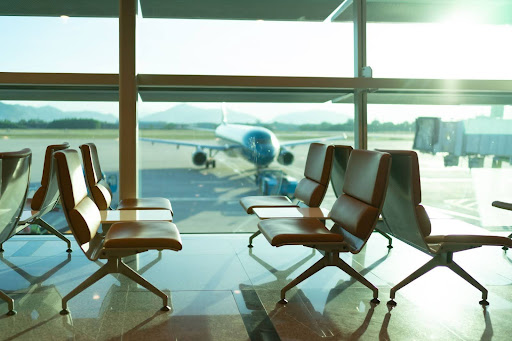
As business travel rebounds in 2026, airports are under growing pressure to serve not just as transit hubs, but as productive, work-conducive environments. For mobile professionals, consultants, and frequent flyers, the ability to work before, after, or between flights is no longer a bonus — it’s a necessity.
But not all airports are equal. Some have embraced this shift by investing in infrastructure, coworking spaces, and biometric efficiency. Others, like Sydney Kingsford Smith Airport (SYD), remain stuck in a legacy model — a space designed for waiting, not working.
This article breaks down how major global airports handle the intersection of travel and productivity, grouping them by strategic approach — and positioning Anytime Offices Botany, just five minutes from Sydney Airport, as a practical, immediate workaround.
1. “5-Star Airports”: The Terminal as a Destination
These are the global flagships — airports that treat the terminal not just as a place to pass through, but as a space to work, unwind, host meetings, and recover from jetlag. These airports invest in a luxury-productivity blend that few others match.
Singapore Changi (SIN)
Widely regarded as the gold standard, Changi offers:
- Changi Lounge (Jewel): A coworking-style lounge with fast Wi-Fi, private rooms, and showers
- Power desks near the Rain Vortex and Forest Valley: Nature-integrated workspace for reducing travel fatigue
- Upgraded 5G and cloud infrastructure (2025–2026): Enabling real-time remote collaboration and large file transfers
- Terminal 5 preview experience: A public exhibition showcasing AI-driven workspaces planned for launch later this decade
Changi doesn’t just accommodate work — it designs for it.
Doha Hamad International (DOH)
Qatar’s flagship offers a high-luxury take on productivity:
- Al Mourjan Business Lounge: Quiet rooms, private desks, a full-service restaurant, and corporate concierge
- The Orchard indoor garden: A public space with ergonomic seating and low noise — ideal for solo or team work
- Biometric immigration and boarding: More desk time, less queue time
Seoul Incheon (ICN)
A tech-forward airport, Incheon offers:
- PC Zones and digital libraries: For travellers without their own equipment
- “Nap & Work Zones” in Terminal 2: Hybrid spaces to switch between sleep and laptop work
- Event-ready design: Suited for business conventions and high-volume professional arrivals
2. Coworking-Forward Airports: Dedicated Workspaces for Travellers
These airports may not have the luxury sheen of Changi or Doha, but they’re ahead of the curve when it comes to integrating coworking models into the airport environment.
Vienna International Airport (VIE)
- AirportCity Space: Over 2,600 m² of flexible workspace, meeting rooms, and event facilities
- Short-term rentals: Booked by the half or full day — ideal for in-transit meetings
Melbourne Airport (MEL)
- Aerofoil Workspace: A polished landside coworking hub with private desks, fast Wi-Fi, and printing services
- Designed for domestic business travellers: Especially valuable for those in-between hotel checkout and flight time
Warsaw Chopin (WAW)
- Airport Offices: A cluster of commercial office buildings adjacent to the terminal
- Ideal for fly-in/fly-out meetings: Popular among lawyers, consultants, and project managers
Dallas/Fort Worth (DFW) & Istanbul (IST)
- Minute Suites (DFW): Soundproof rooms with desks and daybeds, rentable by the hour
- Work Pods & Sleepin’Pods (IST): Quiet, tech-enabled booths for calls, focus, or rest
This model — workspace as an airport amenity — is expanding rapidly in Asia, Europe, and North America.
3. Infrastructure-Focused Airports: Optimising Flow to Maximise Work Time
These hubs focus on reducing travel friction, using smart layout and high-speed connections to create more usable time for passengers — even without formal office infrastructure.
Shanghai Hongqiao (SHA)
- Intermodal fusion: The airport is directly integrated with a high-speed rail terminal
- Minimal transfer time: From train to check-in in under 5 minutes
Tokyo Haneda (HND)
- Proximity to city: Just 15–20 minutes from central Tokyo
- Terminal design: The “wedge” layout and trained ground crews deliver world-class turnaround speed
Munich Airport (MUC)
- Space-sensing queue tech: Opens new check-in counters automatically when lines grow
- Logical flow: Avoids bottlenecks, freeing up time for passengers to relax or work
Atlanta Hartsfield-Jackson (ATL)
- Linear layout and Plane Train upgrade (2026): Ensures sub-90-second transfers between terminals
- High throughput, low delay: The world’s busiest airport is also one of the fastest for connections
4. Minimalist Movers: Prioritising Speed, Not Comfort
These airports aim for maximum efficiency, often for business travellers who value speed over amenities.
London City (LCY)
- Business-first security: Uses no-liquid-limit scanners and digital fast-track lanes
- Compact design: Gate-to-curb time measured in minutes
Boston Logan (BOS)
- Walkability over automation: Few internal transfers; passengers can reach most gates on foot
- Best for short-haul U.S. business routes
Copenhagen (CPH)
- Consistently ranked for fast security screening
- Minimalistic terminal design: Quick access, low friction
Dubai International (DXB)
- Smart Tunnel immigration: ID check happens while you walk through a lighted corridor
- Focus is on speed, not workspace
5. The Friction Zones: Where Work Still Isn’t an Option
Despite handling millions of international passengers each year, some major airports remain hostile to productivity.
Sydney Kingsford Smith (SYD)
- No public coworking spaces
- No rentable day offices
- Lounge access only for Business/First or Priority Pass members
- Station Access Fee of $17.92 (2026) on train arrivals — penalising group or eco-conscious travel
- Drive-up parking exceeds $60/day without advance booking
Sydney is a textbook example of how real estate pressure and outdated design can make an airport unusable for work — even though it’s a gateway to the entire Asia-Pacific.
The Alternative: Anytime Offices Botany – Sydney’s Near-Airport Hub
In the absence of airport-supplied coworking, Anytime Offices Botany offers a real-world workaround for working professionals:
- Located 5 minutes from SYD terminals at 1401 Botany Road
- Day-use offices, hot desks, and meeting rooms
- Available by the hour or day
- Enterprise-grade fibre internet, showers, kitchen, and free coffee
- Free, unmetered street parking — no boom gates or timed tickets
Scenario: You’ve checked out of your hotel at 10 AM. Your flight isn’t until 7 PM. The airport offers no viable place to work. Instead, take an Uber to Botany, get a day pass, finish your work, refresh with a shower, and leave for the terminal only when needed.
This is not a compromise. It’s a superior productivity strategy.
Conclusion
The future of air travel is not just about flying — it’s about how you work while moving. The best airports in the world have already adapted. They offer coworking lounges, sleep pods, high-speed connectivity, and intermodal efficiency.
Sydney Airport, for all its global traffic, has not. But with options like Anytime Offices Botany, Sydney-based travellers don’t need to wait for an overhaul. The infrastructure for work-while-travelling already exists — just outside the airport perimeter.
Recent Comments